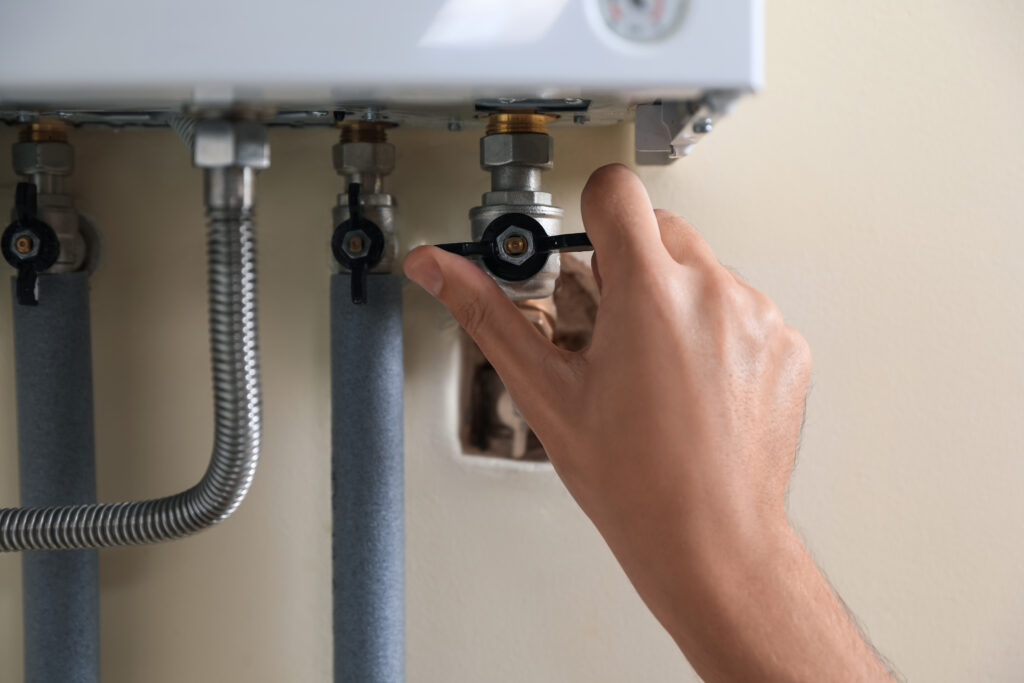
You turn the tap, wait the usual few seconds, and nothing warm arrives. Having no hot water is one of those faults that goes from mildly annoying to genuinely disruptive in about a day, and the temptation is to ring the first plumber you find and hope for the best.
Hold off for ten minutes. A fair share of the callouts we attend across the Gold Coast and Logan turn out to be a tripped switch, an off-peak supply window, or a unit asked to do more than it was sized for. None of those need a plumber.
We have been repairing and replacing hot water systems here since 1978. This guide runs the checks in the order we run them ourselves, split by system type, with a clear line drawn around the jobs that are legally ours rather than yours.
Before Anything Else: The Gas Smell Rule
If you can smell gas near the unit, stop reading and act. Do not flick switches, do not use your phone inside, and do not go looking for the leak.
Get everyone outside, turn the supply off at the meter or the LPG bottle if you can reach it safely, leave doors and windows open, and call 000 from a safe distance. The Queensland Government’s gas safety guidance is blunt about this, and so are we. Both natural gas and LPG are odourised precisely so a leak is easy to pick up.
No gas smell? Good. Carry on.
Step 1: Work Out What You Are Actually Looking At
The fault pattern depends entirely on the system, so this is not a step to skip. Head outside and find the unit.
- Electric storage: a tall cream or white cylinder, usually against an external wall or in a laundry cupboard, with a switch or isolator nearby.
- Gas storage: similar shape, but with a flue on top and a gas line running in. Older units have a viewing window near the base for the pilot light.
- Continuous flow gas: a compact rectangular box on an outside wall, no tank. Needs both gas and a power point to run.
- Solar: roof panels or evacuated tubes, a tank either up there or at ground level, plus an electric or gas booster.
- Heat pump: a tank with what looks like a small air conditioner attached, and a fan you can hear running.
Photograph the data plate while you are there. Brand, model and capacity save a lot of back and forth later.
Step 2: Is It the Whole House or Just One Tap?
Run the hot tap at a different fixture, ideally in another room. If every outlet is cold, the problem is at the system. If one tap is cold and the rest are fine, the system is working and the fault is at that fixture: a failed mixer cartridge, a partly closed isolation valve, or a blocked aerator. Check the cold side too, because a pressure drop everywhere points to a mains supply issue rather than a hot water fault.
Step 3: Electric Storage, Power First and Then Your Tariff
This is where most Queensland households find their answer, and where most national troubleshooting guides stop short.
Check the switchboard
Open the switchboard and look for a breaker labelled hot water, HWS or water heater. If it has tripped, reset it once. Check the isolation switch near the unit too, which is easy to knock off while gardening. If the breaker trips again straight away, leave it off and call an electrician. A repeat trip usually means a failed element or water where it should not be.
Check what tariff you are on
Here is the part that catches people out. Plenty of Queensland electric storage systems are wired to a controlled load tariff, which means Energex decides when your tank is allowed to heat. Supply is not constant, and it is not something your plumber controls.
On the Energex economy tariffs, a Volume Controlled Night connection (often shown on your bill as Super Economy or Tariff 31) gets a minimum of eight hours a day, generally around 10pm to 7am. A Volume Controlled connection (Economy or Tariff 33) gets a minimum of sixteen hours, usually outside the 4pm to 9pm window.
Those windows move. Energex has been shifting the timing away from managing the evening peak and towards soaking up the middle of the day, when rooftop solar is pouring into the grid. In practice, supply to controlled load appliances is now often cut during the morning peak and resumed around midday. If your hot water has started running out at 7am when it never used to, that shift is the likely explanation and there is nothing wrong with your tank.
Check the meter box
Energex lists a faulty receiver in the meter box among the reasons a household loses hot water, alongside a faulty thermostat, a tank not filling properly, and the simplest one of all, using more than usual. If you suspect the network supply has dropped out, their cold water fault line runs 24/7 on 13 62 62. That call can save you a callout fee entirely.
Step 4: Gas Storage, the Pilot Light and the Supply
Start by confirming you have gas at all. Fire up a gas cooktop if you have one. Nothing there either? Check your LPG bottle level, or contact your retailer about a natural gas supply issue. Empty bottles are the most common cause of a sudden cold shower on the hinterland blocks around Logan.
If the gas is on, look at the pilot light through the viewing window at the base of the unit. On older systems with a standing pilot you can relight it yourself, following the instructions printed on the appliance precisely.
A pilot that lights then dies within a minute or two is telling you something specific. It is usually a failed thermocouple, the safety device that shuts the gas off when it cannot detect a flame. The part is cheap, but fitting it is licensed gas work.
Step 5: Continuous Flow Gas, Power, Flow and Error Codes
Continuous flow units surprise people because they need electricity as well as gas. If the power point beside the unit has been switched off, or the circuit has tripped, you get cold water from a system that looks perfectly healthy from outside.
Check the power point, check the breaker, then look at the display panel. Most brands throw a numbered error code, and that code tells a gas fitter more in two seconds than any description will. Write it down before you call.
If the unit fires but the water is only lukewarm, flow rate is often the cause. These systems need a minimum flow to trigger the burner, so a partly closed tap or a scaled-up shower head can leave you just under the threshold. Two showers at once on an undersized unit does the same.
Where there is no gas smell and the unit simply will not ignite, switching it off at the power point, waiting a minute and switching it back on is a safe reset worth trying once. Anything past that, including burner work, valve adjustments or removing a cover, belongs to a licensed gas fitter. Our gas plumbing team handles Type A appliance work on both natural gas and LPG.
Step 6: Solar and Heat Pump, Look at the Booster
Solar systems carry an electric or gas booster for cloudy runs and heavy use. After a week of Gold Coast rain, the booster is the first suspect. Find its switch, confirm it is on, and check its breaker at the switchboard.
Heat pumps have their own tells. Stand next to the unit and listen. If the fan is silent, check the power and the breaker. Some models also drop into a fault state after a power interruption and need a reset at the controller. Our explainer on how heat pump hot water systems work covers what normal operation sounds like.
Warm but Never Hot? Check the Tempering Valve
If your water is reliably warm but never properly hot at every bathroom tap, the tempering valve is a strong candidate.
Australian plumbing rules limit the temperature delivered to bathroom fixtures to prevent scalding, while the tank itself is held hotter to keep bacteria in check. A tempering valve does that blending, and when one starts to fail it drifts. The symptom is exactly this: not cold, not hot, just permanently disappointing. Replacing one is quick, and it sits under our tempering and thermostatic mixing valve service.
Where the Line Sits in Queensland
Plenty of the checks above are yours to make. Resetting a breaker, flicking an isolator back on, relighting a standing pilot to the manufacturer’s instructions, ringing Energex about your tariff: all fine.
Past that, the rules are tight. The QBCC requires regulated plumbing work to be carried out by a licensed plumber or drainer, and installation, replacement, valve work and pipework all sit inside that. Gas work is licensed separately and more strictly again. Unlicensed work also gives your insurer a clean reason to knock back a water damage claim, which is a rough way to learn the rule.
No Hot Water: the Mistakes That Cost People Money
- Resetting a tripped breaker over and over: once is diagnosis, three times is asking for trouble. Repeat trips mean a real fault.
- Cranking the thermostat up: it does not make a failing element work, and it raises your scalding risk.
- Ignoring a hissing or constantly dripping relief valve: some discharge is normal, constant discharge is not, and it drives your water bill up while you wait.
- Replacing the whole unit for a $60 part: thermocouples, elements, thermostats and valves are all replaceable. Get a diagnosis before a quote for a new system.
- Assuming a 20-year-old tank is worth repairing: the reverse mistake. Past about fifteen years, repair money is often better spent on a replacement.
- Not writing down the error code: it clears when the unit resets, and with it goes the fastest diagnosis available.
Frequently Asked Questions
Why do I have no hot water in the morning but plenty at night?
That pattern points squarely at a controlled load tariff on an electric storage system. Your tank heats during the window Energex allows, and if that window has shifted or the household is drawing more than the tank holds, you run dry before the next heating period. Check which tariff your hot water is on with your retailer.
How long should hot water take to come back after a reset?
An electric storage tank generally needs two to four hours to recover, longer for larger capacities. Continuous flow gas is near instant once it fires. If an electric system has had no power for a day or more, give it a full heating cycle before deciding it has failed.
Can I relight the pilot light on my gas hot water system myself?
On older units with a standing pilot, yes, following the instructions printed on the appliance. Modern systems with electronic ignition have no pilot to relight. If it will not stay lit, or you smell gas at any point, stop and call a licensed gas fitter.
How long does a hot water system last?
Electric and gas storage tanks typically run eight to fifteen years, with water quality and whether the sacrificial anode was ever changed making a real difference. Continuous flow units often go longer. Once a system is well past a decade and facing its second or third repair, replacement is usually the better spend.
Should I call a plumber, an electrician or Energex?
If the breaker holds and the unit has power but the water is cold, call a plumber. If the breaker trips repeatedly or the circuit is dead, call an electrician. If you suspect the network supply to a controlled load system has dropped out, call Energex on 13 62 62 first. Any gas fault beyond an empty bottle is a licensed gas fitter’s job.
Still Cold? Give Us a Call
If you have worked through the checks and the water is still cold, you have already done the useful half of the diagnosis, and whoever attends will get to the answer faster for it.
Charlie The Plumber has been repairing, servicing and replacing hot water systems across the Gold Coast and Logan since 1978. We are a family-owned team rather than a franchise, we work on every major brand including Rheem, Rinnai, Dux, Aquamax, Bosch and Vulcan, and we will tell you straight whether yours is worth repairing. Have a look at our hot water system services, or get in touch and we will get you back under a hot shower.